At the request of some centers, we provide a link in case you are interested in practicing the activity online
|
Problems for the sprint on February 18, 2026.
Teams of 1st and 2nd year of ESO
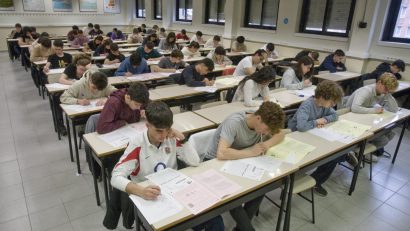
On February 18, 2026, the latest edition of the 2025-2026 academic year of the activity was held Sprint Problems.
- There was a great success in participation: 199 teams from 151 centers, from Catalonia, the Valencian Country, and the Balearic Islands.
- Most centers submitted correct answers to the 10 main problems of the activity. Some very quickly, others with more working time. As we have said, from the organizing team in recent calls, we are pleased to think that the activity is becoming more of a Popular problem-solving race, which emphasizes collaborative work to reach solutions to problems over the competitive interest of going very, very fast. So we must thank the teachers who made it possible
- There was also a very interesting response to the bonus problems.
As we did at the time, we must apologize for a technical anomaly that disrupted the functioning of the registration form and the response submission forms mid-morning. This greatly hindered the participation of some teams; from the organizing team, we tried to resolve it as quickly as we could, with great concern because we have experienced the activity in the classroom and we are very sorry that the children's work could not function properly for a certain number of teams whose responses did not appear on the scoreboard. For some of these teams, the responses were saved, and we have attempted a manual analysis to publish results. This circumstance and some others are delaying the publication of the activity's chronicle. We also apologize for this. We hope it will be published in full detail very soon.
Information about the activity on February 4, 2026
Sprint problems for high school teams
Participation
- Participation has been 52 teams from 51 schools schools
- It has been recorded 884 students in the participating teams.
- You can consult the list of participating teams, which, on this occasion, have been essentially one per center and relatively large teams, which has surely influenced the overall good results.
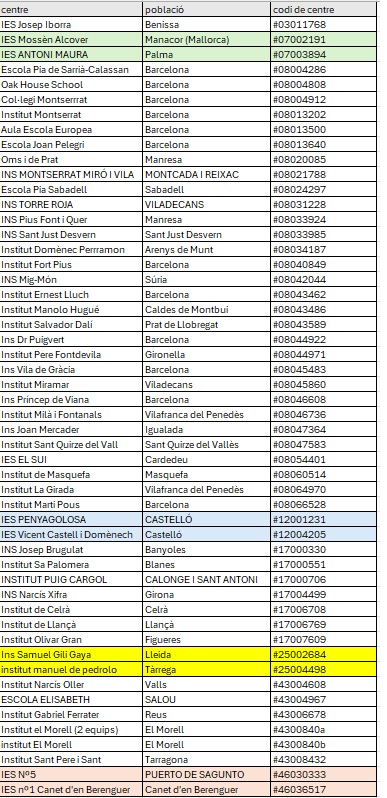
- The geographical distribution of the participating centers, which you can see in the list ordered by center code, has been quite diverse:
1 team from the province of Alicante; 2 from Mallorca; 30 from the province of Barcelona (of which 12 from the city of Barcelona); 2 from the province of Castellón; 7 from the province of Girona;
2 from the province of Lleida; 5 from the province of Tarragona; 2 from the province of Valencia.
Results
The organization considers the results to have been brilliant, understanding that teamwork, collaborative and participatory spirit to achieve success is the priority objective, ahead of «sprinting». Many centers were seen with quick success, and many others dedicated a long time to achieving success. Well!!!
We hope that the centers and team members also value the activity very positively.
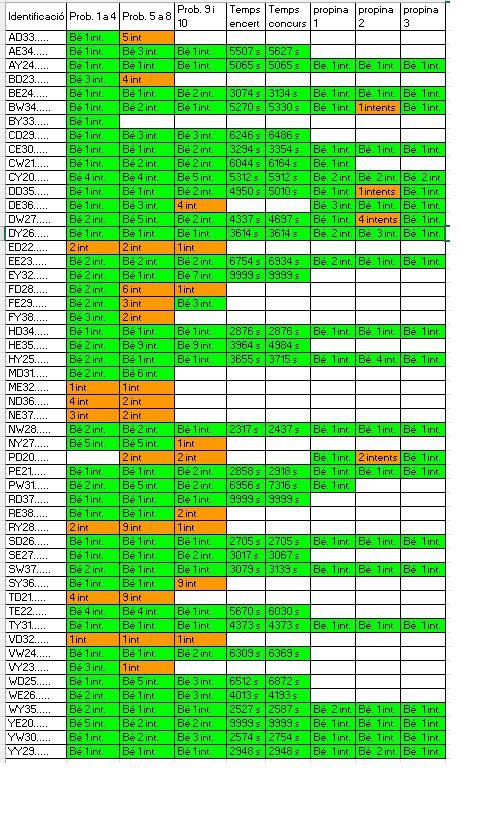
- 32 teams have achieved full accuracy, a very interesting result.
- 24 teams have worked on the bonus challenges, all of them with some success, of which 18 achieved success in all 3 bonus challenges. Well done!!!
- You can check the activity scoreboard (link) where you can see by columns: the first four characters of the password (which mark the order of presentation); the result in the first group of problems; the result in the second group of problems; the result in the final challenges; time of success if achieved; the competition time with an accumulation of one minute for each failed attempt, and the result of the answers to the bonus problems.
From the team coordinating the activity, we appreciate the messages received from some participating centers that properly value the level and variety of the problems posed, which have allowed a good number of teams to follow the key idea with which the activity is designed: collaborative work that has led to success.
Outstanding teams
We indicate with (#) the centers that have achieved success in the competition challenges without any mistakes (very good!!!) and with (*) success in bonus challenges.
- The fastest team has been Institut Ernest Lluch, from Barcelona (***) with a competition time of 2437 seconds. Other teams would complete an expanded podium, given ex-aequo, who did it in less than three-quarters of an hour or just a bit more:
the’Institut Vila de Gràcia, from Barcelona (***) ,
the’IES Vicent Castell i Doménech, from Castelló de la Plana, (#) (***)
i Oak House School, from Barcelona (***).
- In less than an hour of competition time or just a bit more (listed in order of time) they have sent the correct solutions:
Aula Escola Europea from Barcelona (#) (***), Institut Pius Font i Quer from Manresa (***), Manolo Hugué Institute from Caldes de Montbui (#) (***), Institut Manuel de Pedrolo from Tàrrega, IES Penyagolosa from Castelló (***), Institut Torre Roja, from Viladecans (***), Olivar Gran Institute from Figueres (***), Escola Pia de Sarrià-Calassanç of Barcelona (#) (***) and Institut Montserrat from Barcelona (***).
We want to acknowledge all the teams that have achieved success, who all deserve a big congratulations:
- In an hour and a half or less: Institut Pere Fontdevila from Gironella, Institut La Girada Vilafranca del Penedès (#) > (***), Institut Samuel Gili Gaya Lleida (**), Escola Elisabeth from Salou , Institut Josep Brugulat from Banyoles (**), Institut de Masquefa (#)(***), Institut Gabriel Ferrater from Reus (**).
- In less than two hours, Institut Dr Puigvert Barcelona, Institut Sant Quirze del Vallès (***) , Institut El Sui, from Cardedeu, Institut Narcís Oller from Valls (*), Institut de Sant Just Desvern, Institut Narcís Xifra from Girona, Institut de Celrà, Institut Montserrat Miró i Vilà, from Montcada i Reixac (***) and Institut de Llançà (*)
- and we want to make a special mention of three teams: Institut Miramar from Viladecans, IES Antoni Maura, from Palma (#) , and Collegi Montserrat, from Barcelona (***),
Col·legi Montserrat, from Barcelona, who have honored the current idea of a popular race that is a priority for many participating teams: they have spent a lot of time achieving total success. From what they have told us, it is possible that they started the activity, stopped to go to some classes, and then finished the problems. Well!!!
As a final detail of this chronicle, we mention two teams that, probably due to a special way their school directed the activity, have succeeded in bonus challenges (statements valued as very appropriate) even if they had not successfully completed the contest challenges: IES Nº 5, from Port de Sagunt (***) and Escola Pia de Sabadell (**).
Link to view the statements
The solutions:
- First group of problems: 5, 9(A+B)/2, 20, 10
- First group of problems: 3/5, 2h2, 6/25, 6!
- Final challenges: 40, 3 p/2
- Bonus problems: 56, 7, 35
Information about the activity on January 21, 2026
Sprint problems for 5th and 6th grade of primary school
Participation
- Participation has been 44 teams from 24 schools (23 from Catalonia and 1 from the Valencian Community)
- It has been recorded 982 students in the participating teams.
- You can consult the list of participating teams, which shows the different treatment the activity allows depending on the organization each center wants to give it, an aspect that can influence the results.
Results
As has been happening in recent editions, the results have been brilliant, with the understanding that teamwork, collaborative and participatory spirit to achieve success becomes the priority objective, ahead of «sprinting»:
- 23 teams have achieved total success, a fact that the organizing committee values very positively.
- In this sense, each center will have to evaluate the results with the team members. It is well known that the activity allows for very diverse organizations, but «relatively large» teams with collaborative work are more in line with the idea of the activity. On the other hand, in some centers «small teams» were formed, and this has meant that, in these cases, overall success was scarce. Be that as it may, we congratulate the participating teams and thank the centers for their interest in the activity.
- 16 teams worked on the bonus challenges, all of them with some success, and 10 with success in all 3 bonus challenges. Well!!!
- You can check the activity scoreboard (link) where you can see, by columns: the first four characters of the password (which characterize it); the result in the first group of problems; the result in the second group of problems; the result in the final challenges; time of success if achieved; the contest time with an accumulation of one minute for each failed attempt, and the result of the answers to the bonus problems.
From the team coordinating the activity, we thank the messages received from some participating centers that highlight that the students enjoyed this mathematical team experience. This is the key idea with which the activity is designed.
Outstanding teams
We indicate with (#) the two centers that have succeeded in the contest challenges without any errors (very good!!!) and with (*) the success in bonus challenges.
- The fastest teams have been: one of the teams from’Elisabeth School, from Salou, (**) which solved the 10 challenges of the contest in less than half an hour has been, and one of the teams from the’Thau School, in just over half an hour. Other teams would complete an extended podium, which we give ex-aequo, that did it in less than three-quarters of an hour: a team from Sant Lluís School, from Barcelona (#)(***) and the teams from the’Manresa School Institute, from Manresa (***), and the’La Floresta School from Sant Cugat del Vallès.
- In less than one hour of contest time, they have sent the correct solutions: two teams from Carme Guasch i Darné School. from Figueres (one ***, the other **); Josep Pallach School, from Figueres (#)(***); the’Sinera School, from Arenys de Mar, and Pia de Sarrià-Calasanç School, from Barcelona (***).
We want to acknowledge all the teams that have achieved success, who all deserve a big congratulations:
- In an hour and a half or less: another team from Thau School, from Barcelona; Saint George's School from Fornells de la Selva; FEDAC Manresa from Manresa; Mare de Déu de Montserrat from Les Borges Blanques; Betania-Patmos School from Barcelona; Agora Sant Cugat from Sant Cugat del Vallès (***); Laia, from Barcelona (***), and Santa Anna School from Lleida.
- In less than two hours, two teams from’Aula Escola Europea, from Barcelona; another team from Escola Elisabeth from Salou and a team from John Talabot School of Barcelona
- and we want to make a very special mention of the‘Peda Blanca School, from La Pera, which has honored the current idea of a popular race that is a priority for many participating teams: it has spent a lot of time achieving total success.
As a final detail of this chronicle, we mention teams that, probably due to a special way their school directs the activity, have been successful in bonus challenges (we were told they were very well-stated challenges) even if they had not successfully completed the contest challenges: Pia Sant Miquel School, from Barcelona; some teams from John Talabot School, from Barcelona, and a team from El Carme School, from Tarragona.
- Link to view the statements. An advisory committee, and some messages from centers (thanks!!!) have valued them very positively.
- Solutions
- First group of problems: (1) 8; (2) 6b+4a; (3) 13; (4) Figueres
- Second group of problems: (5) 3; (6) if the number is mnpq answer 22+m+n-p-q; (7) 16; (8) 40
- Final challenges: (9) there are 15 cars and 25 motorcycles (25); (10) 987654
- Bonus problems: (P1) in 9 squares the largest of which is 4×4; (P2) there are many sums that meet this; all teams that tried it got it right on the first try; (P3) 242
Information about the activity on December 10, 2025,
Sprint problems for 3rd and 4th year ESO teams
Participation
- 194 teams of 143 educational centers from Catalonia, the Valencian Community, and the Balearic Islands
- A total of 3,560 students. were recorded as members of the teams, which, as always, have been organized following the criteria of each center.
- This data represents a record at this level of the activity.
- You can consult the list of participating teams, where the different treatment that the activity allows according to the organization each center wants to give it is noted.
The results
In this edition, the results have been brilliant and show that the collaborative and participatory spirit takes precedence a bit over the interest in «sprinting»: the activity is increasingly understood as a popular problem-solving race, where the main objective is not speed, but reaching the end of the course successfully through reasoning, debate, and teamwork.
- 49 teams have correctly solved all the problems of the contest
- 52 more teams have sent correct answers to the first eight challenges. Among these teams, some formed exclusively by 3rd year ESO students stand out, who have communicated their satisfaction with the results achieved.
- You can check the activity scoreboard (link) where you can see, by columns: the number characterizing the password; the result in the first group of problems; the result in the second group of problems; the result in the final challenges; time of success if achieved; the contest time with accumulated penalty for failed attempts, and the answer to the bonus problems. Due to a technical anomaly, for which we apologize, the answers to the second bonus problem were not recorded. In the following lists of teams with a special congratulations, we indicate with (*) or (**) the recorded success in one or two bonus challenges.
The messages received from many participating centers highlight that the students experienced the activity as a profitable and motivating time. This is the key idea with which the activity is designed.
Outstanding teams
- The fastest teams , which solved the 10 challenges of the contest in less than an hour, which we list in order of contest time but somewhat ex-aequo were: the, from Tàrrega (Urgell), the’Institut Manuel de Pedrolo from Cardedeu (Vallès Oriental), and the’Institut Arquitecte Manuel Raspall from Lleida (Segrià)’Institut Samuel Gili Gaya In a second group we will indicate the teams that achieved total success in less than three-quarters of an hour. Like the previous ones, we list them in order of contest time, but we also want to present them as a group:
- Col·legi La Salle , from Palma (Mallorca) (*),, from Barcelona (Barcelonès) (*), Col·legi Sant Lluís Institut la Sedeta, from Barcelona (Barcelonès), , from Manresa (Bages) and, Institut Pius Font i Quer, Institut El Pedró , from l'Escala (Alt Empordà) and, at the limit of this time, Institut Domènec Perramon d'Arenys de Munt (El Maresme) (*) all teams that had success
We want to acknowledge all the teams that have been successful. We have grouped them into three groups according to the time taken; in each group they are listed in order of registration. We insist that they all deserve congratulations, and those in the third group, who have dedicated more time (even in some cases it seems there has been a period dedicated to other activities but they have returned to mathematical work to meet the challenge of sending answers to all problems) we also say: very good!
- Institut Santa Eugènia de Girona (*); Maristes Sant Pere Chanel de Malgrat de Mar; Aula Escola Europea de Barcelona; Institut La Sedeta de Barcelona (3 teams) (one *), Institut Giola de Llinars del Vallès; Institut Torre Roja de Viladecans; Institut Montserrat Miró i Vilà, de Montcada i Reixac (*); Institut de Vidreres; Institut de Sant Just Desvern; Institut Ernest Lluch de Barcelona (*); Institut Alexandre Deulofeu de Figueres
- Institut Josep Brugulat de Banyoles; Institut Montsacopa d'Olot; Institut Martí Pous de Barcelona; IES Penyagolosa, de Castelló; Institut de Masquefa; Oak House School, de Barcelona; Institut de Santa Coloma de Farners (*); Institut Can Margarit de Corbera de Llobregat; Institut La Girada de Vilafranca del Penedès (*); Institut Vila-seca; Col·legi Regina Carmeli de Rubí; Institut Pere Fontdevila, de Gironella
- Institut de Cassà de Selva; Institut Camps Blancs de Sant Boi; IES Vicent Castell i Domènech de Castelló (**); Institut Jaume Callís de Vic (*); Institut La Segarra de Cervera; Institut Jonqueres de Sabadell; La Salle de Girona; Institut Montgrós de Sant Pere de Ribes; IES nº1 de Canet d'en Berenguer (*); La Salle de Reus; Institut Antoni Torroja de Cervera; Institut Ermessenda de Girona de Girona; Agora Sant Cugat de Sant Cugat del Vallès (**); Institut de Tremp; Institut Ronda de Lleida
Teams with total success without any mistakes
Another fact we usually highlight is the teams that have achieved total success without any mistakes. They are the following (in order of registration):’Institut Martí Pous (Barcelona),’Institut Domènec Perramon (Arenys de Munt),’Institut Vidreres (Vidreres), and’Institut La Sedeta (Barcelona), the latter with two teams.
Bonus problems
As a final detail in this detailed review of results, we mention the answers to the bonus challenges. Perhaps it is noted that the average working time of the teams was higher than other times. Or perhaps the bonus problems were more difficult? The fact is that there have not been many successes in this aspect. As already mentioned, in the previous lists (**) means two successes, (*) one. We therefore highlight IES Vicent Castell i Domènech de Castelló and Agora de Sant Cugat del Vallès, to which we can add’Institut Vilamajor, de Sant Pere de Vilamajor, and’IES la Plana, de Castelló, which, although they did not have total success, did send correct answers to both bonus challenges.
Statements. Link to a PDF with the proposed challenges. It can be seen that some statements (problems 1 and 5, and 7 and 3 which link to the previous ones) depend on each team's password.
Solutions:
First group of problems (1 to 4): 90+A/2; 301; Q*15; 16
Second group of problems (5 to 8): 3S/8 ; 30; 9R/7; 6
Final challenges (problems 9 and 10): 3 & 256; sqrt(3) i.e. 1.7321
Bonus problems: 81; 5; 3/8
We recall that in the sprint problem statement it says
The key idea for organizing the activity is: a team = group of students gathered in a classroom working in groups and subgroups who share ideas and results and collaborate with each other
and with this premise the statements are designed, which also states, in case there are students of different school levels in the team, that the first group of problems can be for the younger ones, the second group of problems for the older ones, and the final challenges for everyone.
However, from the organization we note that there are schools that find it more fitting to their teaching approach to make teams of few students; quite a few in this edition. It is good that the activity has different possible approaches, but it is also clear that small teams find it harder to achieve success, if they achieve it at all.
We have also received comments about «the use of artificial intelligence». From the organizing committee, since the contest must be carried out under the supervision of the teaching staff, we understand that this is not the objective and that each school will adequately supervise the work of the children and young people.
Be that as it may, congratulations to everyone for dedicating time to a collaborative activity.