

















How much time should be set aside for the activity?
The centers that do it best (those that send all answers first) usually take about an hour.
There is usually a group of centers that also send everything correctly, taking more than an hour and a half, or two hours…
But of course, the idea is for students to spend some time on problems, discuss them among themselves, etc… and if a center thinks they can dedicate a certain amount of time and hasn't managed to get all the solutions… they have still done a good job. In all editions, there are also many such centers.
What is the best time to do the activity? Since it was difficult to “agree with everyone” on this aspect, currently each center does it at the time that best suits its organization. It is worth noting that some centers do it during class time, while others do it as a voluntary activity outside school hours… and they are very happy with it!
No prior registration is required. On the “D-day” at a time that works for you, you fill out the form, and then the activity time starts counting.
There is no individual student registration, but rather the center's team; only the name and details of a teacher are requested.
For the teams invited to the awards ceremony… then the names of the team members are requested.
How many students can form the team?
Considering the diversity of “ways of doing things” in centers, it has always been believed that the best thing to put in the instructions is “each center will organize the team as best suits them.” Various variants have been observed: centers that do it with a few selected students and others that do it as classwork, i.e., with a very large team. But probably the most common is that a group of interested students does it.
The key idea for organizing the activity is: One team = a group of students gathered in a classroom working in groups and subgroups.
Can two independent groups participate in one center? And at different times?
Yes; it is planned that two teams working independently can participate in the same center. Perhaps we could say that a team means students gathered in a classroom who help and collaborate with each other. There is no impediment to two teams from a center participating at different times, working independently. Since it is assumed that participants want to “enjoy solving problems,” it is also assumed that they “will not cheat” and that the team participating first will not give the answers to the team participating second…
The structure of the activity could be summarized by saying that “a team is made up of students working in the same classroom.”.
Two subgroups. The idea is that the team splits into two “levels,” two subgroups.
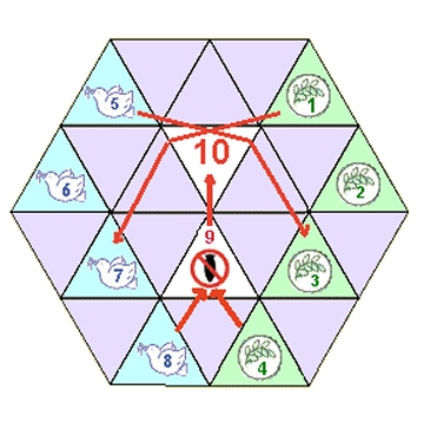
It is intended that one subgroup starts with the first set of problems (what we call the olive branch) and, at the same time, another subgroup can work on the second set of problems (what we call the peace dove). Finally, everyone helps each other and works on the two final challenges. And if more time is wanted, two “bonus” challenges are proposed for the whole team to work on together.
Why aren't the “more difficult” problems the two final challenges? Although it is always very subjective to assess the difficulty of problems, “fine-tuning” the previous point a bit, we would say that the activity is designed so that the first group of problems is worked on by the subgroup of students made up of, let's say, the younger ones (those at the lowest school level); we say these problems are “perhaps the easiest.” At the same time, another subgroup (imagine the older ones, those at the highest school level) can work on the second group of problems (the idea being that these are “the most difficult” and may eventually imply “knowing everything done in the first year corresponding to the edition”). Finally, the two final challenges, which are supposed to involve everyone, are no longer aimed at “the older ones.”.
In many centers, they form relatively large groups, and this is what some successful centers have told us: each subgroup splits up and compares results before sending them. Imagine we have 9 third-year students and 9 fourth-year students. We make three subgroups of 3 in third year and three subgroups of 3 in fourth year. The three third-year subgroups work, but before sending results, they check their results and see if they match… Similarly for the fourth-year ones. And at the end, they all work together, but perhaps not “all in a group,” but rather they solve the problem separately and compare results.
Key idea: comparison of results and collaboration. The idea with which, several years ago, we designed the sprint problems was based on collaboration between different groups of students, the comparison of results, and the eventual debate of “let's see who has it right” and, above all, understanding the “why” seemed enriching to us. The feedback received over these years encourages us to continue with this idea.
On March 20, 2003, ignoring the massive previous citizen mobilizations against the war, and disregarding the United Nations Security Council, which had declared it illegal, the invasion of Iraq began by a coalition formed by the armies of some countries.
On the same day, March 20, 2003, the Kangaroo test was held in our country. Some students decided not to take the Kangaroo test as a sign of protest. Although the organizing committee (which at that time supported the Sprint Problems) found this decision surprising, we wanted to show our support for these students and join the almost unanimous outcry against the war. And we did so by redesigning the presentation board of the sprint problems with the reference “No to war.”.
Since the situation has not substantially changed and since we will always embrace the idea of “No to war,” we have so far seen no reason to change the image of the presentation board of the Sprint Problems.