Contests

Problem Marathon 2025

This telematic activity is being called for the 15th year «Problem Marathon», designed as an individual telematic contest for solving problems. It is aimed at students in 3rd and 4th year of ESO (although exceptionally younger students participate, with the recommendation that it be based on the advice of a teacher from the school). A key idea is to encourage ESO students to see that thinking, in their free time, about how to solve math problems can be very rewarding.


Individual scores for problems 13 and 14 and in the contest can now be consulted.
The list of prizes and the best overall scores has been published.

CURRENT EDITION INFORMATION

In this fifteenth edition of this individual telematic contest for solving math problems, aimed at 3rd and 4th year ESO students (or exceptionally younger students, on the recommendation of their teachers), 15 problems have been proposed:

  • 12 with concrete answers and automatic evaluation, some worth 2 points, others 3, and others 4, which could award a maximum of 37 points
  • Three «explain» problems, for which a detailed reasoned answer is required, each evaluated by a jury of 4 or 5 teachers (active or retired), and the average score was awarded, rounded up to the first decimal. Each problem is graded out of 7 points, but, as stipulated in the rules, in one case an extra tenth was awarded on top of the 7-point valuation to highlight the special merit of the explanation received.

On the proposal of the contest jury, after analyzing the scores, viewed individually and in comparison with other contestants, and other aspects of the contest, the SCM has agreed to award one first prize and two second prizes and extend a cordial congratulations to all contestants mentioned on this page in the list of best scores.


You can consult statistical data on participation and correct answers


Contest prizes

  • First prize
    • Pol Martínez Vázquez, a 3rd year ESO student at La Salle Bonanova, Barcelona
  • Second prizes:
    • Irati Papió Jiménez, a 4th year ESO student at Institut Jaume I, Salou
    • Oriol Segura, a 4th year ESO student at Cardenal Vidal i Barraquer School, Cambrils

Best overall scores

Below is the list of contestants who have obtained 44 points or more out of a maximum of 58, with the points in the set of closed-answer problems and the sum of points in the three explain problems indicated in parentheses.

  • Pol Martínez Vázquez, a 3rd year ESO student at La Salle Bonanova (Barcelona) with 58.1 points (37 + 21.1)
  • Irati Papió Jiménez, a 4th year ESO student at Institut Jaume I (Salou) with 56.9 points (37 + 19.9)
  • Oriol Segura, a 4th year ESO student at Cardenal Vidal i Barraquer School (Cambrils) with 56.3 points (37 + 19.3)
  • Xavier Arimon Olivares, a 4th year ESO student at Institut Manolo Hugué (Caldes de Montbui) with 55.4 points (37 + 18.4)
  • Èlia Margalef Martí, a 4th year ESO student at Cardenal Vidal i Barraquer School (Cambrils) with 55.1 points (37 + 18.1)
  • Daniel Jiménez Milán, a 4th year ESO student at Cardenal Vidal i Barraquer School (Cambrils) with 55 points (37 + 18)
  • Dídac Atao Salazar, a 4th year ESO student at Institut Santa Eulàlia (Terrassa) with 54.3 points (36 + 18.3)
  • Alejandra Martín Alba, a 4th year ESO student at Institut Manolo Hugué (Caldes de Montbui) with 54.1 points (35.5 + 18.6)
  • Eloi Alcaraz Carazo, a 4th year ESO student at Institut Manolo Hugué (Caldes de Montbui) with 53.1 points (37 + 16.1)
  • Jordina Pi Mas, a 4th year ESO student at Institut Montilivi (Girona) with 52.7 points (35.5 + 17.2)
  • Pau Pino Jacomet, a 4th year ESO student at Institut Montilivi (Girona) with 52.6 points (33.5 + 19.1)
    Guillem Subirats, a 3rd year ESO student at Institut Samuel Gili i Gaya (Lleida) with 52.4 points (33.5 + 18.9)
  • Santiago Bretón Botines, a 4th year ESO student at Pureza de María School (Sant Cugat del Vallés) with 52 points (37 + 15)
  • Ignacio Alonso Garcia, a 4th year ESO student at Institut d'Almenara with 51.7 points (37 + 14.7)
  • Roger Canals Marcos, a 3rd year ESO student at Institut Nou de Vilafranca del Penedès with 51.6 points (33 + 18.6)
  • Vahe Arsenyan Kobalyan, a 4th year ESO student at Col·legi Sant Lluís (Barcelona) with 50.4 points (37 + 13.4)
  • Yile Liu, a 4th year ESO student at Col·legi Sant Lluís (Barcelona) with 50 points (35 + 15)
  • Laura Pisa Romero, a 4th year ESO student at Ramar School (Sabadell) with 49.7 points (33.5 + 16.2)
  • Miquel Garcés Merchan, a 3rd year ESO student at Casal dels Àngels School (L'Hospitalet de Llobregat) with 47.9 points (37 + 10.9)
  • Mayda Pardo, a 3rd year ESO student at Col·legi Sant Lluís (Barcelona) with 46.7 points (37 + 9.7)
  • Jep Salat Farguell, a 2nd year ESO student at Institut de Guissona with 46.3 points (28 + 18.3)
  • Adriana Martínez Rovira, a 4th year ESO student at Petit Estel la Nova School (Terrassa) with 45.8 points (31.5 + 14.3)
  • Lluria Torras Arcusa, a 3rd year ESO student at El Cim School (Vilanova i la Geltrú) with 45.2 points (37 + 8.2)
  • Roger Cabanilles Serra, a 2nd year ESO student at Institut Badia i Margarit (Igualada) with 44.9 points (35 + 9.9)
  • Milena Arsenyan, a 1st year ESO student at Col·legi Sant Lluís (Barcelona) with 44.6 points (37 + 7.6)

We reiterate the congratulations already expressed earlier. We want to place special emphasis on the three contestants from the first cycle of ESO who appear on this list and, naturally, the fact that the winner of the contest obtained an extra score in one of the explain problems


CALL FOR

A problem from the first Kangaroo

This year we are developing the 15th Olitele, but it is interesting to remember that the 30th Kangaroo is being celebrated.

Do you know a proposal that recalls problems, one from each kangaroo? You might like it!

As a complement, we will recall some others here. Today, a problem from the first Kangaroo, number 26 of level 2 at that time for 2nd year of BUP and some experimental 4th year of ESO:


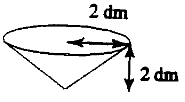
A conical container, with a height of 2 dm and a base radius of 2 dm, is full of water.

The contents are emptied into a cube with an edge of 2 dm. At what height, in dm, does the water reach inside the cube?

One of the answer options was: the water overflows.


DEVELOPMENT OF THE CONTEST

Problems and Scoring Open or Closed Deadline Publication Response Deadline Statements Forms
Problem 0 (worth 2 points) Closed deadline Starts: 20250124 Ends: 20250217 Statement Form
Problem 1 (worth 2 points) Closed deadline Starts: 20250214 Ends: 20250224 Statement Form
Problem 2 (worth 2 points) Closed deadline Starts: 20250214 Ends: 20250224 Statement Form
Problem 3 (worth 3 points) Closed deadline Starts: 20250221 Ends: 20250303 Statement Form
Problem 4 (worth 3 points) Closed deadline Starts: 20250221 Ends: 20250303 Statement Form
Problem 5 (worth 3 points) Closed deadline Starts: 20250228 Ends: 20240310 Statement Form
Problem 6 (worth 4 points) Closed deadline Starts: 20250228 Ends: 20240310 Statement Form
Problem 7 (worth 7 points)
(explanation problem)
Closed deadline Starts: 20250307 Ends: 20240324 Statement Form
Problem 8 (worth 3 points) Closed deadline Starts: 20240321 Ends: 20250331 Statement Form
Problem 9 (worth 4 points) Closed deadline Starts: 20240321 Ends: 20250331 Statement Form
Problem 10 (3 points) Closed deadline Starts: 20250328 Ends: 20240408 Statement Form
Problem 11 (worth 4 points) Closed deadline Starts: 20250328 Ends: 20240408 Statement Form
Problem 12 (4 points) Closed deadline Starts: 20250404 Ends: 20250414 Statement Form
Problem 13 (7 points)
(explanation problem)
Closed deadline Starts: 20250404 Ends: 20250422 Statement Form
Problem 14 (worth 7 points)
(explanation problem)
Closed deadline Starts: 20250411 Ends: 20250428 Statement Form

Statistical data

Registrations: 254 contestants, which are…

  • 114 from 4th year of ESO and 112 from 3rd year of ESO, which are the grades primarily targeted by the contest.
  • Additionally, assuming they followed the indication that a teacher recommended it, 18 from 2nd year of ESO, 8 from 1st year of ESO, and 1 from 6th year of ESO, and one who did not indicate the grade.

Problem 0: 254 responses, of which 217 correct on the first attempt; 8 on the second attempt; 29 incorrect.

Problem 1: 158 responses, of which 148 correct on the first attempt; 6 on the second attempt; 4 incorrect.

Problem 2: 144 responses, of which 93 correct on the first attempt; 23 on the second attempt; 28 incorrect.

Up to problem 2: We highlight 87 contestants with 3 correct on the first attempt (6 points); 24 with two correct on the first attempt and one on the second attempt (5 points), and 34 with 4 points (two correct on the first attempt and one error; or one correct on the first attempt and two on the second attempt)


Problem 3: 105 responses, of which 74 correct on the first attempt; 12 on the second attempt; 19 incorrect.

Problem 4: 102 responses, of which 75 correct on the first attempt; 5 on the second attempt; 22 incorrect.

Problem 5: 87 responses; of which 54 correct on the first attempt; 11 on the second attempt; 22 incorrect.

Problem 6: 84 responses, of which 60 correct on the first attempt; 14 on the second attempt; 10 incorrect.

First set of closed-answer problems: from 0 to 6: We highlight 32 contestants with 7 correct on the first attempt (19 points). With six correct on the first attempt and some error, there are a total of 13 contestants (1 with 18 points, 9 with 17.5 points, and 3 with 17 points). Additionally, there are 13 contestants with 16.5 or 16 points; and another 7 with 14 points or more.


Problem 8: 57 responses, of which 47 correct on the first attempt; 7 on the second attempt; 3 incorrect.

Problem 9: 56 responses, of which 42 correct on the first attempt; 5 on the second attempt; 9 incorrect.

Closed-answer problems including 0 to 6, plus 8 and 9: We highlight 23 contestants with the maximum of 26 points. We also note that there is one contestant with 25 points; 7 with 24.5 or 24 points; another 6 with 22 points or more; another 7 with 20 points or more.


In the last three closed-answer problems, the trend of correct answers for problems 8 and 9 improved even further. Excellent! Very good!

Problem 10: 56 responses, of which 52 correct on the first attempt; 3 on the second attempt; 1 incorrect.

Problem 11: 52 responses, of which 48 correct on the first attempt and 4 on the second attempt.

Problem 12: 45 responses, of which 40 correct on the first attempt; 4 on the second attempt; 1 incorrect.

Overall score of contestants with the highest scores in the closed-answer problems:

  • 20 contestants with the maximum of 37 points
  • 6 contestants between 35.5 and 36 points (inclusive)
  • 8 contestants between 33.5 and 35 points (inclusive)
  • another 9 with 29 points or more.

There were 53 responses to problem 7. The evaluation team (six people, active or retired secondary school teachers) has considered the set of received works very interesting.

Individual scores can now be consulted. It should be noted that in some cases, two indications specified in the problem statement and the response form had to be taken into great account: that the wording of the submitted response must be personal work (with the different meanings of this word) and that the response must be concrete and precise (and that is why if there are aspects that can be considered unnecessary, as is known, this can be seen as a clear loss of precision)

Assessments:

  • 4 contestants with the maximum of 7 points
  • Another 8 contestants with more than 6.5 points
  • Another 8 contestants with more than 5.75 points
 

RELATED NEWS