









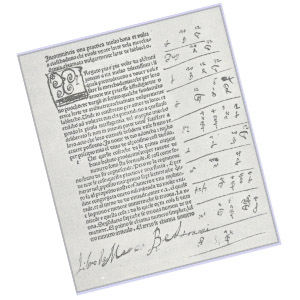


In 1832, the Hungarian mathematician Farkas Bolyai published a book titled Tentamen juventutem studiosam in elementa matheseos purae elementaris ac sublimioris, methodo intuitiva, evindentiaque huic propria, introducendi. In this book, there is an appendix written by his son János.
The subject of this appendix is Euclid's fifth postulate, known as Axiom XI at that time, due to the influence of various texts that included common notions among the postulates.
In about 26 pages, János develops from the axioms of the geometry of space, without using the fifth postulate, a new, completely consistent geometry in which all of Euclid's postulates except the fifth are satisfied.
The fundamental tool that allows him to move forward is the horosphere: orthogonal trajectories to bundles of parallel lines. He sees that the geometry of the horosphere, where the lines are now horocycles, is Euclidean. Then, by projecting figures from his space onto the horocycles and applying Euclidean geometry there, he can prove many results of what is now known as hyperbolic geometry: the law of sines (in a triangle, the ratio between the sine of an angle and the hyperbolic sine of the opposite side is constant), the circumference of a circle ($2\pi\sinh(r)$), the angle of parallelism ($\Pi(y)=2\arctan(e^{-y/R})$), etc.
He was also able to successfully handle the topic of areas and volumes, complicated in hyperbolic geometry where there are no squares; areas are essentially derived from volumes.
As János told his father: out of nothing I have created a new and different world!. A world where the circle can be squared, as János already states in the title.
This work has had an extraordinary influence not only on the development of mathematics but also on the history of science in general, on philosophy, on physics, etc.
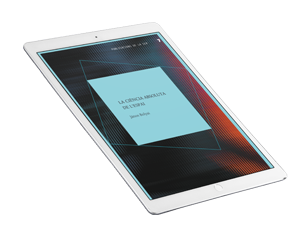
For all this, and because the original version is very condensed and difficult to read, it seemed convenient to have a Catalan version. This version is already available (go to the link https://publicacions.iec.cat/
The absolute science of space /János Bolyai; work translated and commented by Agustí Reventós.