















GENERAL DESCRIPTION
This thematic session brings together research groups from across Catalonia working in stochastic analysis, with a particular focus on topics closely related to those addressed in the plenary lecture by Dan Crisan. The session will showcase the rich interplay between stochastic analysis and a broad spectrum of mathematical disciplines, featuring talks on mathematical analysis, partial differential equations, financial mathematics, and climate modelling. It aims to foster scientific exchange and highlight recent advances at the interface of these research areas.
____________________________________________________________________
SCHEDULE
Dijous 8 d’octubre (Nicolau d’Olwer)
11:00h Explicit domain preserving integrators for a class of SDEs, David Cohen (Chalmers University of Technology, Gothenburg)
11:40h Inference and Estimation in Second-Order Markov Multistate Models: Theory, Simulations, and Clinical Application, Mireia Besalù (Polytechnic University of Catalonia)
12:20h Kac-Stroock type approximations for the Brownian motion, Salim Boukfal (Autonomous University of Barcelona)
Divendres 9 d’octubre (Pi i Sunyer)
11:00h Takagi-Type Curves: SBR measure and Local Time, by Frank Proske (University of Oslo)
11:40h On the skew-curvature power law relationship in stochastic volatility models with Lévy jumps, by Òscar Burés (University of Barcelona)
12:20h On counting processes, Anthony Réveillac (National Institute of Applied Sciences, Toulouse)
____________________________________________________________________
ABSTRACTS
Takagi-Type Curves: SBR measure and Local Time
by Frank Proske (University of Oslo)
Abstract
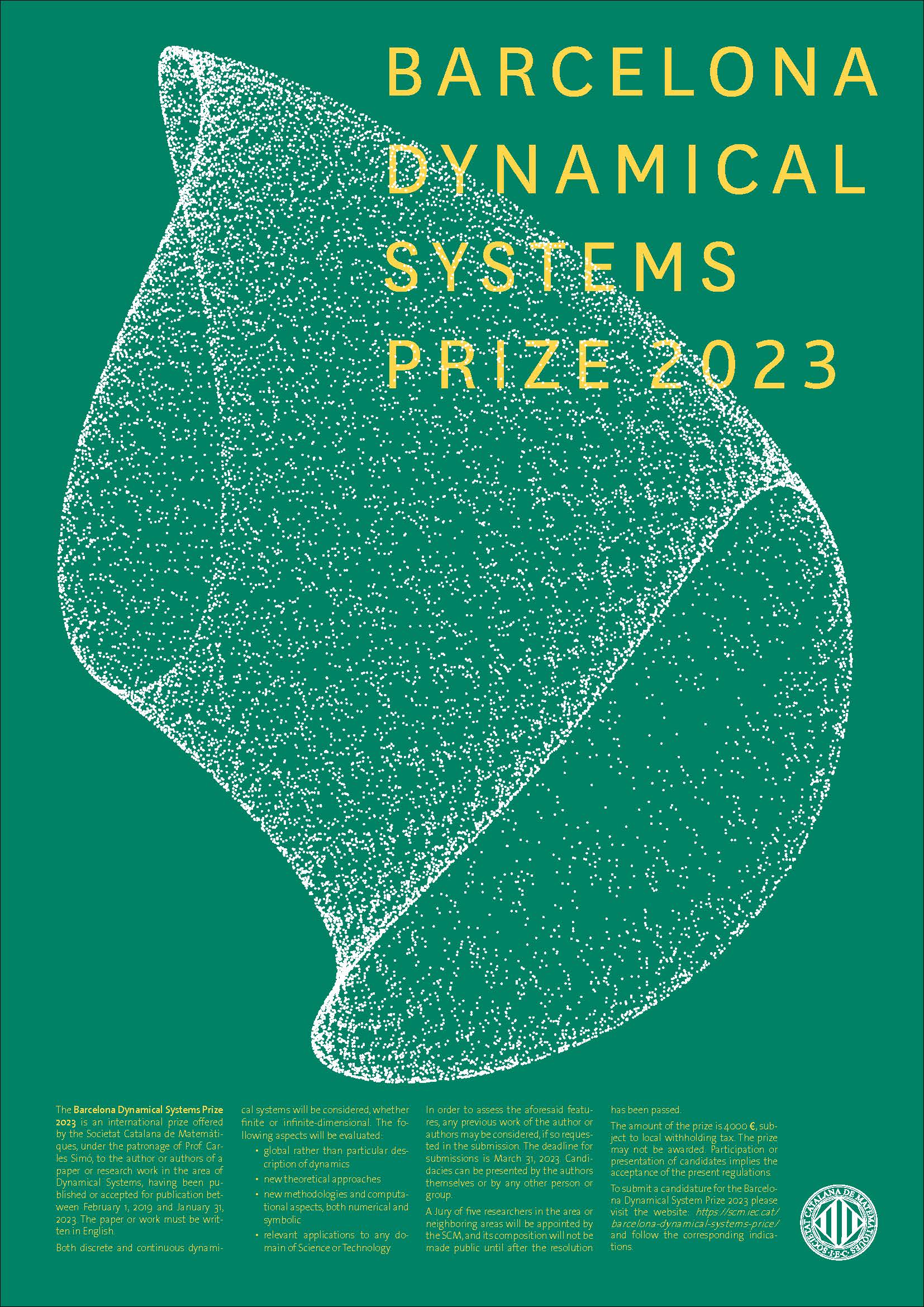
We investigate occupation measures and local times of rough Takagi-type functions. By embedding these curves into a hyperbolic dynamical system related to the baker transformation, we establish a connection between SBR measures, Bernoulli convolutions and occupation measures. Using Fourier-analytic and equidistribution methods, we prove the existence of square-integrable local times for Takagi-type curves for specific ranges of the roughness parameter. The motivation for this work also comes from stochastic regularization theory, where irregular perturbations can restore well-posedness of differential equations.
References
[1] K. Barański, B. Bárány, J. Romanowska. On the dimension of the graph of the classical Weierstrass function. Advances in Mathematics 265 (2014), 32–59.
[2] P. Imkeller, O. Menoukeu Pamen, G. dos Reis, A. Réveillac. Rough Weierstrass functions and dynamical systems: the smoothness of the SBR measure. Pure and Applied Functional Analysis 7 (2022), 1273–1305.
____________________________________________________________________
Kac-Stroock type approximations for the Brownian motion
by Salim Boukfal (Autonomous University of Barcelona)
Abstract
This talk provides an overview of results concerning the weak approximation of Gaussian processes such as Brownian motion, its multiparameter analog, the Brownian sheet, and stochastic integrals with respect to such processes to finally see how these results can be applied to approximate the law of the solution to the stochastic Poisson equation. We mainly focus on approximations constructed from integrated random telegraph processes whose switching rates are described by a renewal process.
____________________________________________________________________
Explicit domain preserving integrators for a class of SDEs
by David Cohen (Chalmers University of Technology, Gothenburg)
Abstract
We propose and study explicit time integrators for SDEs having solutions in a hypercube.
We provide strong and weak rates of convergence for these domain preserving integrators.
We illustrate these results numerically.
The talk is based on a joint work with Charles-Edouard Bréhier (Université de Pau et des Pays de l’Adour)
____________________________________________________________________
On the skew-curvature power law relationship in stochastic volatility models with Lévy jumps
by Òscar Burés (University of Barcelona)
Abstract
The short-term blow up behaviour of the ATM-IV skew is commonly modelled by either a rough volatility process with small Hurst index or an infinite variation Lévy process in the log-price dynamics. In this talk we examine which is the effect of mixed dynamics (i.e. rough volatility and infinite variation Lévy processes) on the ATM-IV skew and curvature. The results show that the analysis of the leading terms of the short-time expansion of both ATM-IV skew and curvature allow us to determine, from a mixed dynamics model, which mechanism originated the power-law behaviour on the skew and on the curvature. Apart from showing that the mixed model also originates a power law, the results have also key implications in model design and calibration.
____________________________________________________________________
On counting processes,
by Anthony Réveillac (National Institute of Applied Sciences, Toulouse)
Abstract
Motivated by question in Cyber Risk Insurance modelling, we investigate some general structure on counting processes. Indeed, we are interested on how one can capture inner dependence structure of random events and like the notion of cluster in case of contagion-type phenomena. We address this question using Malliavin’s calculus type tools in line with recent developments we produced in this direction. This talk is based on a joint work with C. Hillairet, T. Peyrat and A. Pommier.»
____________________________________________________________________
Inference and Estimation in Second-Order Markov Multistate Models: Theory, Simulations, and Clinical Application
by Mireia Besalú (Polytechnic University of Catalonia)
Abstract
Multistate models are widely applied to describe the clinical course of a disease and to model the progression of patients among various health states. Standard methodologies rely on the first-order Markov assumption, where the future evolution of the stochastic process only depends on the current state and often fails in complex clinical scenarios. To address this limitation, we extend the traditional framework by relaxing this assumption to a second-order Markov process, where future state transitions depend on both the current and immediate past states.
To overcome the high-dimensional estimation challenges inherent to higher-order transitions, we utilize state-specific extended transition probability matrices and generalize the Chapman-Kolmogorov equations for $n$-step second-order probabilities.
In this work, we propose two consistent, non-parametric estimators under time-homogeneity for these transition probabilities: a direct ratio of conditional transitions to individuals at risk, and an averaged estimator based on time-specific conditional probabilities. We establish their asymptotic properties and derive explicit variance formulas.
Finally, we demonstrate the utility of our framework using a cohort of over 3,000 hospitalized COVID-19 patients in Barcelona. The multistate model captures 14 possible transitions among seven distinct post-admission states.We have observed possible differences in patient progression to non-invasive and invasive mechanical ventilation based on initial pneumonia severity, differences that would not be detectable under a first-order Markov assumption.
This is a joint work with Josu Najera-Zuloaga and Guadalupe Gómez Melis.